
Change the unit to change the course
Our economy rests on assumptions that work against us: they push towards individualism and give power to those who accumulate money. Here is the reasoning that led to the vector currency.
The diagnosis
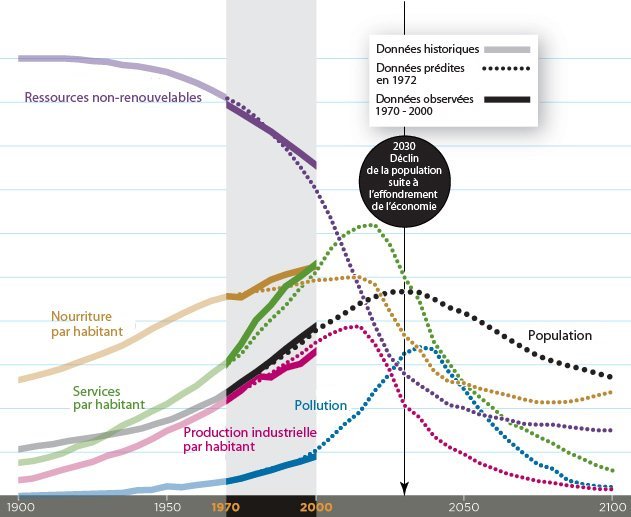
The projections of the Meadows report (1972) have held true for fifty years.
The Meadows report, published in the early 1970s and then checked against real data in the 2000s, confirmed the trends it had predicted. A quick reading of this mathematical model reveals the major threats ahead: social instability, overpopulation, depletion of natural resources, collapse of biodiversity, famine, lack of drinking water, rising pollution and disease, climate change, and possibly wars or a global economic collapse.
What can we do?
We looked for the most far-reaching lever to bend these curves. Religions, cultures and traditions shape societies, but they do not lend themselves to deliberate action. What all societies have in common is the exchange of goods and services: the economy.
Hence the question that gave birth to the project: how can our market economy help us meet the challenges ahead, instead of making them worse?
A vector currency
An idea developed between 2002 and 2014.
A vector currency expresses a value with several components. Without realising it, we already use one, with a single vector: quantity. Having 50 euros means owning a quantity of 50.
Let us add a second vector, quality. The wallet then reads as follows:
It holds 50 units with a qualitative value of 2.1, the equivalent of 105 euros today. The qualitative vector gives meaning to our purchases and actions: how we earn and how we spend matter as much as the amount.
A full study of a currency with ten vectors is available in the white papers.
Measuring the real usefulness of an activity
Each criterion can take a positive or a negative value.
The system assesses the usefulness of all human activities. This assessment results in a score, passed on to those who use the service: whoever works, buys or rents. Passed on step by step, it gradually improves consumption patterns.
For the social usefulness of companies, we proposed ten criteria, five tending to be positive and five tending to be negative:
- −Resources used
- +Measures taken to protect these resources and ecosystems
- −Waste
- −Pollution generated
- −RisksAssessed at several scales (local, regional, national, humanity) and on several levels: environmental, social, societal.
- −The precautionary principleDoes the activity carry a risk, even an unproven or unknown one?
- +Products made
- +Usefulness of the productsAt the social and societal levels.
- +The wider service provided by the companyWith reference to Maslow's hierarchy of needs, and to other criteria yet to be defined.
- +Cooperation and mutual supportWith peers and competitors, or with civil society.
Physical quantities, settled in time
Over time, we wanted to reduce the subjective part of the model by valuing goods and services with physical quantities: water, energy, resources, waste, pollutants, land area, durability.
So that people can govern their own currency, each component is converted into time, the unit of exchange, through a floating rate based on the actual state of resources at any given moment. A kilo of waste might, for example, cost 0.2 hours of life.
At the moment of payment, all the components come down to a single value: time. Buying stays simple, but every price keeps a record of what it cost the planet.